
The Ultimate Guide to Getting Your U.S. Passport Fast Everything You Need — One Page — No Guesswork
Blog post description.
1/17/20264 min read
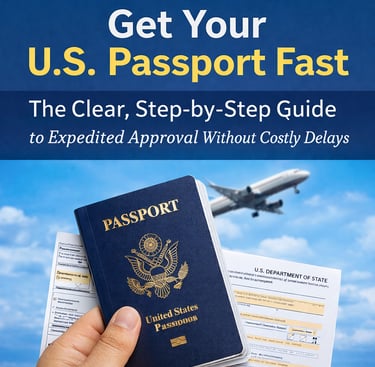
The Ultimate Guide to Getting Your U.S. Passport Fast
Everything You Need — One Page — No Guesswork
If you’ve read multiple articles, checked official instructions, and still feel uncertain, you’re not alone.
Most people don’t fail to get a passport fast because they didn’t try hard enough.
They fail because the process is fragmented.
Information is scattered.
Rules are explained without context.
Critical decisions are buried under paperwork.
This page exists to fix that.
It brings everything that actually matters into one place—so you can stop jumping between sources and start moving forward with confidence.
Why This Page Exists (And Why You Should Start Here)
The U.S. passport process isn’t hard because it’s complicated.
It’s hard because it’s sequence-dependent.
If you do the right things in the wrong order, you lose time.
If you do the wrong things confidently, you lose even more.
This guide is structured the way the system actually works—not the way instructions are written.
The One Rule That Controls Everything
Before anything else, understand this:
Speed is decided before you submit.
Not after.
Not when you pay.
Not when you track.
Every delay you’ve read about traces back to one of three root causes:
Wrong path
Wrong category
Wrong assumptions
Fix those, and most problems disappear.
Step 1: Choose the Correct Processing Path
There are only three paths that matter:
Standard Processing
Best when time is flexible. No urgency. Lowest risk.
Expedited Processing
Best when you want faster review and you can submit a clean, correct application immediately.
Urgent Travel Handling
Designed for imminent travel. Strict eligibility. Limited availability.
These are not “speed levels.”
They are different routes.
Choosing the wrong one doesn’t slow you down gradually—it stops you.
Step 2: Identify Your Application Category (No Guessing)
The system immediately classifies you as one of the following:
First-time applicant
Renewal
Replacement (lost, stolen, or damaged)
This classification determines:
Which form applies
Whether in-person verification is required
Which documents are acceptable
There is no flexibility here.
Most silent delays happen because applicants assume renewal eligibility when it doesn’t apply.
Step 3: Forms Are Routing Commands, Not Paperwork
The form you choose tells the system:
Who you are
Which rules apply
How strict review will be
Common form-related delays happen because of:
Wrong form selection
Incomplete fields
Inconsistent names or dates
Incorrect signatures
One wrong detail can pause everything.
This is not bureaucracy.
It’s system logic.
Step 4: Passport Photos — The Hidden Gate
Passport photos are not judged by appearance.
They are judged by technical compliance.
Most rejections happen because of:
Shadows
Uneven lighting
Background texture
Head positioning
Glare or obstructions
A photo that “looks fine” can still stop your application cold.
Under expedited processing, photo errors are devastating because they erase your speed advantage.
Step 5: Supporting Documents — Precision Beats Volume
The system only wants documents for three reasons:
Citizenship
Identity
Eligibility
Anything else is noise.
Extra documents:
Increase review time
Trigger manual checks
Create inconsistencies
More paperwork is not safer.
It’s slower.
Step 6: Fees and Payment — The Non-Negotiable Gate
Payment is not symbolic.
It’s a validation step.
If payment is wrong:
Processing does not begin
Expedited status doesn’t matter
Time is lost silently
Common mistakes include:
Missing required fees
Incorrect totals
Wrong payment method
Payment should be boring.
Boring is fast.
Step 7: Appointments — Required or Risky
Appointments are not shortcuts.
They are required only when:
In-person verification is mandatory
Urgent travel handling applies
Chasing unnecessary appointments:
Adds steps
Introduces availability delays
Slows everything down
Mail-based expedited processing is often faster when eligibility allows it.
Step 8: Special Situations Change the Rules
Lost, stolen, or damaged passports are not routine.
These cases:
Require reporting
Trigger stricter identity checks
Have less margin for error
Treating them like renewals is one of the most expensive mistakes applicants make.
Step 9: Urgent Travel — When Time Is Truly Short
When travel is less than 14 days away:
Options narrow
Mistakes are fatal
Guessing ends everything
Urgent handling is not guaranteed.
It’s eligibility-based and availability-limited.
At this stage, calm execution matters more than speed.
Step 10: Tracking Without Panic
Most delays are silent.
“In process” does not always mean moving.
Silence does not mean success.
Smart tracking means:
Confirming receipt
Watching for requests
Recognizing abnormal silence
Overreacting causes damage.
Ignoring signals causes worse damage.
When Expedited Processing Fails
Sometimes timelines simply don’t align.
When that happens:
Stop forcing the wrong path
Protect your application record
Avoid panic decisions
Reassess realistically
Failure is survivable.
Panic is not.
The Pattern Behind Every Successful Fast Passport
People who get passports quickly—without drama—do the same things:
They verify instead of assuming
They choose the correct path once
They submit clean, minimal applications
They track intelligently
They stay calm under pressure
They don’t chase speed.
They remove friction.
The One Skill That Creates Speed
Everything on this page points to one skill:
Decision sequencing.
Knowing:
What must be decided first
What depends on those decisions
What happens if you guess
That skill saves more time than any shortcut ever will.
Final Reality Check Before You Act
Before you submit anything, ask yourself:
Do I truly know which path applies to me?
Do I know my correct category?
Am I acting on clarity or stress?
If there’s doubt, pause.
Five minutes of clarity can save weeks.ng
If you want to stop piecing together advice and start moving forward with certainty, you don’t need more articles.
You need a system.
The Get Your U.S. Passport Fast guide gives you:
The full decision framework
Step-by-step execution
Real explanations of real delays
A final checklist to submit with confidence
👉 Get the Complete Expedited Passport Guide
It’s built to sit between official instructions and real life—
where most people actually lose time.
Because the fastest passport application isn’t the one that tries harder.
It’s the one that understands the system—and submits once, correctly.https://expeditedpassportusa.com/passport-fast-guide
Contact
Fast help with your passport needs
infoebookusa@aol.com
© 2026. All rights reserved.