Supporting Documents for Expedited Passports: What to Include (And What to Leave Out)
Blog post description.
1/3/20263 min read
Supporting Documents for Expedited Passports: What to Include (And What to Leave Out)
When expedited passport applications slow down, most people assume something is missing.
Very often, the opposite is true.
They included too much.
The U.S. passport system is not impressed by thoroughness. It is optimized for specific verification. When applicants submit documents that are unnecessary, unclear, or inconsistent, they trigger extra review—and extra review kills speed.
If you want expedited processing to work, you must understand exactly which documents matter and which ones quietly slow you down.
Why Supporting Documents Exist (And What They’re Not For)
Supporting documents serve only three purposes:
Prove citizenship
Confirm identity
Establish eligibility
They are not there to:
Tell your story
Explain mistakes
Show effort
“Help” the reviewer
Anything that doesn’t serve one of those three purposes is noise.
And noise creates delay.
The Most Common Documentation Mistake
The biggest mistake applicants make is assuming that more documents equal a stronger application.
So they include:
Extra IDs
Old passports that aren’t required
Copies of unrelated records
Personal explanation letters
This backfires.
Each extra document forces the reviewer to ask:
Why is this here?
Does it conflict with other information?
Does it require verification?
Every question adds time.
Originals vs Copies: Where People Lose Weeks
One of the most dangerous misunderstandings is submitting the wrong format.
Some documents must be original.
Some must be copies.
Submitting the wrong version can:
Pause processing
Trigger a request for resubmission
Reset review timelines
Many applicants assume originals are always safer. They aren’t.
Following the instruction exactly is faster than “upgrading” it.
Proof of Citizenship: Precision Beats History
Citizenship proof must be:
Valid
Readable
Relevant to your current application
Problems arise when applicants submit:
Damaged documents
Unclear copies
Documents that don’t match current records
Even if citizenship is unquestionable, unclear proof forces manual verification.
Manual verification is slow—especially under expedited timelines.
Proof of Identity: Consistency Is Everything
Identity documents must align perfectly with:
Your application form
Your passport photo
Any supporting records
Small mismatches—middle names, spacing, date formatting—can trigger review holds.
These holds don’t look dramatic. They just stop progress.
Name Changes: Zero Margin for Assumptions
Name changes introduce complexity, not flexibility.
Applicants often assume:
The change is obvious
The connection is clear
A partial record is enough
The system does not assume.
If the connection between names is not explicit, review pauses.
This is one of the most common silent delays in expedited cases.
Why Extra Documents Slow You Down
Extra documents create three risks:
Inconsistencies
Unnecessary verification
Manual review
Even documents that “support” your case can hurt if they introduce new data points.
The fastest application answers only the questions that are asked.
Replacement Cases: Documents Matter Even More
Lost, stolen, or damaged passport cases are reviewed more strictly.
Submitting:
Incomplete documentation
Irrelevant records
Mixed eligibility materials
almost guarantees delay.
Replacement cases require clean, focused documentation—nothing else.
Expedited Processing Does Not Fix Documentation Errors
Expedited service does not:
Fill gaps
Ignore mismatches
Speed up corrections
It simply prioritizes review of what you submit.
If what you submit is unclear, expedited review just finds the problem faster.
The Discipline That Creates Speed
Applicants who move fastest do one thing consistently:
they show restraint.
They submit:
Only what is required
Exactly in the format requested
Without commentary or assumptions
This signals clarity—and clarity moves faster through the system.
How to Submit Supporting Documents Correctly
Before submitting, ask:
Does this document serve a required purpose?
Is it required in this format?
Does it align perfectly with everything else?
If the answer isn’t clearly yes, leave it out.
Want to Eliminate Documentation Delays Entirely?
If you want expedited processing to actually deliver speed, documentation must be clean, minimal, and aligned.
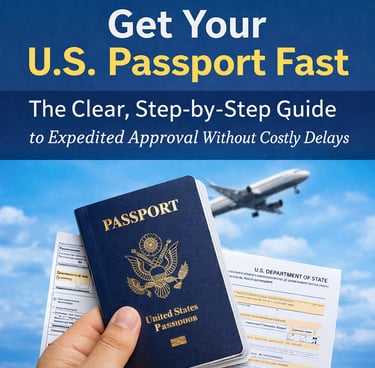
The Get Your U.S. Passport Fast guide walks you through:
Exactly which documents your case requires
What to exclude (and why)
How to avoid silent documentation holds
👉 Get the Complete Expedited Passport Guide
Built for people who don’t have time to fix preventable mistakes.
What Comes Next
Once documents are correct, the next silent delay point is fees and payments.
In the next article, we’ll cover:
Why small payment mistakes stop expedited applications—and how to avoid them.
Because even the fastest application goes nowhere if payment isn’t perfect.https://expeditedpassportusa.com/passport-fast-guide
Contact
Fast help with your passport needs
infoebookusa@aol.com
© 2026. All rights reserved.