How Long It Really Takes to Get a U.S. Passport (Real Timelines, Not Promises) - update 2026
Blog post description.
1/23/20269 min read
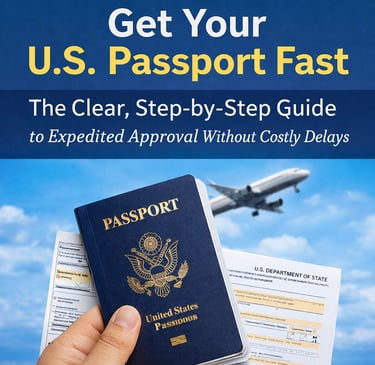
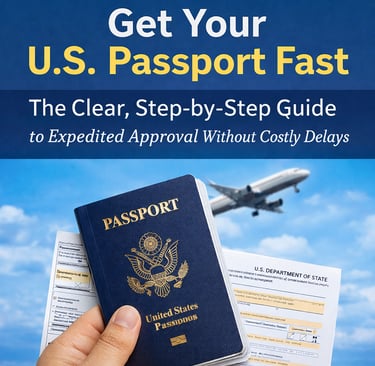
How Long It Really Takes to Get a U.S. Passport (Real Timelines, Not Promises)
Applying for or renewing a U.S. passport is often accompanied by a sense of urgency. Whether you have an upcoming international business trip, a long-awaited family vacation, or an unexpected family emergency abroad, the central question is always the same: When will my passport actually arrive?
If you look at the official U.S. Department of State website, you will find standard estimates for routine and expedited processing. However, any seasoned traveler knows there is a significant difference between official estimates and real-world timelines. Processing times fluctuate throughout the year based on seasonal demand, staffing levels, legislative changes, and technological upgrades within the National Passport Processing Centers.
This comprehensive guide breaks down the real timelines for securing a U.S. passport in 2026. We look past the official marketing promises to give you actionable data, realistic waiting times, hidden bottlenecks, and proven strategies to accelerate your application.
1. The Reality vs. The Promise: Current Processing Windows
The U.S. Department of State categorizes passport processing into specific tiers. To plan your travel accurately, you must understand what these tiers mean in practice and how shipping times impact your final delivery date.
Routine Service
The official promise for routine service typically sits at 6 to 8 weeks.
The Real Timeline: In reality, routine processing averages 4 to 6 weeks during low-demand months (September to January) but easily stretches to 8 to 10 weeks during peak travel seasons (February to August).
The Missing Factor: Official timelines only measure the time your application spends inside the processing center. They do not account for the mailing time required for your documents to reach the government, or the return shipping time via the United States Postal Service (USPS).
Expedited Service
For an additional government fee of $60, you can request expedited service. The official promise is 2 to 3 weeks.
The Real Timeline: Expedited applications generally clear within 14 to 21 days from the day you mail them to the day they arrive at your doorstep, provided you utilize 1-2 day express shipping both ways.
The Bottleneck: If you use standard First-Class mail to send your application, expedited service can still take up to a month total.
Urgent & Emergency Travel (The 14-Day and 72-Hour Windows)
This tier is reserved for travelers with confirmed international departures within 14 calendar days, or those facing a qualified life-or-death emergency abroad requiring travel within 72 hours.
The Real Timeline: Same-day to 3 business days.
The Catch: You cannot simply mail your application for this service. You must secure an incredibly scarce in-person appointment at one of the 26 regional passport agencies across the United States.
Service TierOfficial Government EstimateReal-World Mailing + Processing WindowBest ForRoutine6 – 8 Weeks6 – 10 Weeks (Depending on season)Travelers with no trips planned for 3+ monthsExpedited2 – 3 Weeks3 – 4 Weeks (With standard mail)Travel scheduled within 6 to 12 weeksExpedited + 1-2 Day Delivery2 – 3 Weeks14 – 18 DaysTravel scheduled within 4 to 6 weeksUrgent TravelIn-Person AppointmentSame Day to 72 HoursConfirmed international travel within 14 daysLife-or-Death EmergencyImmediate24 to 48 HoursExtreme medical or familial emergencies
2. The Invisible Timeline: Shipping and Intake Latency
When calculating your travel safety margin, you must account for the "invisible timeline"—the period when your passport application is in transit or sitting un-opened in a government mailroom.
[Your Mailbox] ➔ (2-5 Days Transit) ➔ [Intake Center] ➔ (3-5 Days Data Entry) ➔ [Official Processing Starts]
The Postal Float
When you mail your application via USPS, it travels to a centralized lockbox facility (typically in Philadelphia, Irving, or San Francisco). This transit takes anywhere from 2 to 5 business days. During this window, if you check your application status online, the system will return a frustrating message: "Not Found." This does not mean your application is lost; it simply means it hasn't been scanned into the system.
The Intake Backlog
Once your envelope physically arrives at the facility, it enters a sorting queue. During peak seasons, envelopes can sit in bins for 3 to 7 days before a staff member opens them, verifies the payment check, and scans the barcode.
Crucial Insight: Your official processing window only begins after this initial scan. If you chose routine service in April, your application could easily sit dormant for nearly two weeks before the official "6 to 8 week" clock even starts ticking.
3. The Digital Shift: Online Passport Renewal (OPR)
The Department of State has fully integrated the Online Passport Renewal (OPR) system, allowing eligible adults to renew their documents online without mailing a physical application, check, or passport photo.
Is the Online System Faster?
Technically, the processing times for OPR match the official routine and expedited timelines of paper applications. However, OPR completely eliminates the shipping and intake latency discussed above.
Instant Submission: The moment you upload your digital photo and pay with a credit card, your application enters the digital processing queue.
Time Saved: By bypassing USPS transit and manual mailroom sorting, OPR users frequently report receiving their routine passports within 3 to 5 weeks—significantly faster than the paper equivalent.
Who is Eligible for Online Renewal?
You can bypass the mailroom entirely if you meet these strict criteria:
Your most recent passport is in your possession, undamaged, and was issued when you were 16 years of age or older.
Your previous passport was issued within the last 15 years.
You are not changing your name, gender marker, date of birth, or place of birth.
You live in the United States (either a state or territory).
You can upload a compliant, digital passport photo in JPEG format.
4. Seasonal Fluctuations: When to Apply to Beat the Surge
Passport processing is highly cyclical. The volume of applications received by the government follows a predictable seasonal wave aligned with holiday planning and school vacations.
▲ (Peak Surge: Feb - August) -> Longest wait times, high delay risk / \ / \ / ▼ (Low Demand: Sept - Jan) -> Fast processing, minimal delays
The Peak Surge (February to August)
This is the most hazardous time to submit a routine application. Millions of Americans suddenly realize their passports are expired right before spring break and summer vacations.
Impact on Timelines: Routine applications submitted in March or April routinely stretch to the absolute maximum of the government's estimate, sometimes breaching the 10-week mark.
Expedited Delays: Even expedited services slow down due to the sheer volume of data entry required at intake centers.
The Sweet Spot (September to January)
The autumn and early winter months are historically the quietest periods for the Department of State.
Impact on Timelines: If you apply for a routine passport in October, the processing infrastructure is underutilized. It is incredibly common for routine applications submitted in this window to be delivered in under 4 weeks, effectively giving you expedited speed without paying the additional $60 fee.
5. Top 5 Mistakes That Derail Your Timeline
The biggest variable in passport processing isn't the government—it's user error. Approximately 10-15% of all passport applications are delayed or suspended due to missing information, faulty documentation, or non-compliant photos. When an application is suspended, your timeline resets to zero.
Mistake 1: Non-Compliant Photos (The #1 Culprit)
If your photo fails automated or manual inspection, the agency will mail you a letter requesting a new one. This pauses your application entirely.
Shadows and Lighting: Shadows on the background or across your face cause instant rejection.
Eyeglasses: You cannot wear glasses in a passport photo unless you have a signed medical statement from a physician explaining why they cannot be removed for medical reasons.
Expression: Smiling exaggeratedly or frowning can distort facial biometrics. Aim for a neutral expression or a natural, unexaggerated smile with eyes wide open.
Mistake 2: Incorrect Fees or Payment Methods
Passport fees must be paid via a specific format depending on how you apply.
Mail Applications: You must enclose a personal check or money order made out exactly to "U.S. Department of State." Credit cards are not accepted via mail. If you write the wrong amount (even off by one dollar), or if your handwriting on the check is illegible, your entire packet will be mailed back to you un-processed.
Separated Execution Fees: If applying in person at a Post Office or local clerk's office (Form DS-11), you must pay a $35 execution fee to that specific facility, separate from the main application check sent to the government.
Mistake 3: Signing the Wrong Form at Home
If you are applying for a first-time passport, replacing a lost/stolen passport, or renewing a child’s passport, you must use Form DS-11.
The Rule: You must not sign Form DS-11 until a certified Passport Acceptance Agent instructs you to do so in person. If you sign it at home before your appointment, the agent cannot accept it, and you will have to fill out a brand-new form on the spot.
Mistake 4: Insufficient Identification or Citizenship Documents
You must submit original documents or certified copies of your citizenship evidence (such as a certified birth certificate or naturalization certificate).
Common Error: Submitting a photocopied birth certificate or a hospital commemorative birth souvenir certificate. These are not legally valid for passport issuance. The agency requires a certified copy issued by the state, county, or city vital statistics office, featuring a raised, embossed, or multicolored seal.
Mistake 5: Improper Parental Consent for Minors
For children under the age of 16, both parents or legal guardians must appear in person with the child to authorize passport issuance.
If one parent cannot appear: You must submit a fully completed, notarized Form DS-3053 (Statement of Consent) along with a front-and-back photocopy of that parent's ID. The notarization must be recent (less than 90 days old). Tiny discrepancies in names between the ID, the birth certificate, and the form will cause an immediate freeze.
6. Navigating the 14-Day Urgent Travel System
If you have international travel booked within 14 days and your passport hasn't arrived—or you haven't applied yet—your options narrow drastically. You must enter the high-stress world of Regional Passport Agencies.
Securing an Appointment
To get a same-day passport, you must book an appointment at one of the 26 physical regional agencies. You can attempt to schedule this online or by calling the National Passport Information Center (NPIC) at 1-877-487-2778.
The Shortage: These appointments are fiercely competitive. Phone lines open early, and slots are often snatched within minutes by travelers across the country.
The Location Problem: You cannot pick your agency based on convenience; you must take whatever appointment is open nationally. If you live in Florida and the only open slot is in Chicago, you must fly to Chicago to get your passport printed.
Document Checklist for Urgent Appointments
If you manage to secure an appointment, you must bring absolute proof of your travel emergency:
Proof of Immediate International Travel: A printed airline itinerary, cruise booking, or international hotel reservation showing your name and a departure date within 14 days.
Completed, Unsigned Forms: Bring the appropriate completed application form.
All Supporting Originals: Birth certificates, expired passports, valid driver's licenses.
Passport Photos: Two freshly printed, compliant physical photos.
Payment: Credit cards, checks, or exact cash are accepted at regional agencies.
7. How to Track and Expedite an Existing Application
What happens if you submitted a routine application weeks ago, your travel date is approaching, and you are starting to panic? You can take proactive steps to change your processing tier mid-stream.
Tracking the Status
Visit the official U.S. Passport Application Status portal. Note that it takes up to 2 weeks for your application to change from "Not Found" to "In Process." Once it is in process, you will receive a unique application locator number. This 9-digit number tells you exactly which regional printing facility holds your file.
Upgrading to Expedited Mid-Process
If you realize your routine timeline is too tight, you can call the NPIC (1-877-487-2778) and request an upgrade to expedited service.
The Process: You must provide your credit card details to authorize the additional $60 expedited fee and an optional $21.36 for 1-2 day fast return shipping.
The Reality: This request does not guarantee instant speed. The customer service agent forwards your request to the physical facility holding your paperwork. It can take several days for the facility to process the payment and pull your file into the fast-track lane.
Congressional Interventions: The Last Resort
If you are within 48 to 72 hours of an international flight, your application is stuck "In Process," and you cannot secure a regional agency appointment, you can reach out to your local U.S. Representative or Senator.
Constituent Services: Every member of Congress has a dedicated constituent services team designed to cut through federal red tape.
How it Works: You visit your representative’s official website, fill out a Privacy Release Form authorizing them to act on your behalf, and provide your passport locator number and proof of immediate travel. A congressional staffer will contact the passport agency liaison directly, which often results in the immediate printing and overnight shipping of your delayed passport.
8. Step-by-Step Action Plan Based on Your Travel Date
To remove all guesswork from your passport application process, use this simple timeline blueprint based on how many weeks remain before your flight.
Scenario A: You have 12+ Weeks Before Travel
Action: Apply via Routine Service (either via OPR if eligible or standard mail).
Strategy: Use standard shipping. Save your money and skip the expedited fee. Your safety margin is wide enough to absorb any seasonal backlogs.
Scenario B: You have 6 to 11 Weeks Before Travel
Action: Apply via Expedited Service.
Strategy: Pay the additional $60 government fee. If using a paper application, pay for Priority Mail Express to ship the documents to the lockbox, ensuring it lands in the system within 48 hours.
Scenario C: You have 3 to 5 Weeks Before Travel
Action: Apply via Expedited Service + 1-2 Day Return Shipping.
Strategy: This is a borderline window. You must use OPR if eligible to bypass mailrooms entirely. If you must use mail, enclose a check covering both the $60 expedite fee and the $21.36 fast return shipping fee. Monitor the online tracking portal daily.
Scenario D: You have Less Than 2 Weeks Before Travel
Action: Do not mail anything. You must use the Urgent Travel In-Person System.
Strategy: Call the NPIC exactly 14 days before your trip at 8:00 AM EST sharp to secure a regional agency slot. Gather your flight tickets and paperwork, and prepare to travel to the nearest physical government agency.
Final Summary: Take Control of Your Timeline
The secret to avoiding passport delays is to remove all friction from the system. If you plan ahead, choose the correct season, double-check your check values, and ensure your passport photos are completely free of shadows and glare, you can completely ignore the worst-case timelines.
Never guess your application status. Be proactive, utilize the online renewal system if you qualify, and ensure your travel plans are backed by a real-world safety margin rather than optimistic government promises.
Contact
Fast help with your passport needs
infoebookusa@aol.com
© 2026. All rights reserved.