
Emergency U.S. Passports and Last-Minute Travel: What Actually Works When Time Is Almost Gone
Blog post description.
1/21/202616 min read
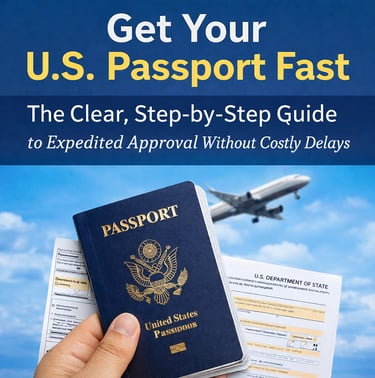
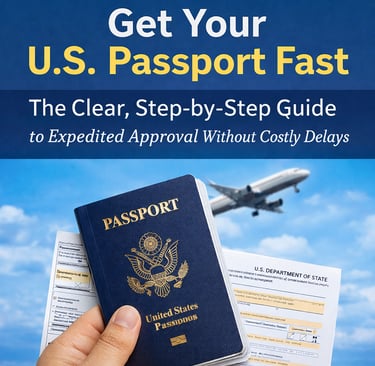
Emergency U.S. Passports and Last-Minute Travel: What Actually Works When Time Is Almost Gone
If you’re reading this, chances are your stomach is already tight.
Maybe your passport just expired.
Maybe you opened the drawer and realized it’s missing.
Maybe a family emergency, business crisis, or once-in-a-lifetime opportunity just appeared—and your flight is days away, not weeks.
When time is almost gone, generic passport advice stops being helpful. You don’t need theory. You don’t need outdated blog posts. You need what actually works, what fails, and what you can still do right now to get a U.S. passport in your hands before departure.
This guide is written for that exact moment.
No fluff. No summaries. No shortcuts. Just real-world emergency passport strategy, written in authoritative American English, based on how the system actually behaves under pressure.
The Reality of Emergency U.S. Passports (No Sugarcoating)
Let’s get one thing straight immediately:
There is no magic button.
There is no guaranteed overnight passport for everyone.
There is no secret online form that bypasses government rules.
Everything that works falls into very specific legal pathways governed by the U.S. Department of State. Anything outside those pathways is either misinformation, a scam, or a misunderstanding that costs people flights every single day.
However—and this is critical—within those pathways, speed is possible if you understand:
Which emergency category you actually qualify for
How appointment systems really work
What documentation matters more than anything else
Where people lose time unnecessarily
How to compress weeks of delay into days (or even hours)
Most people fail because they treat passport emergencies like a normal application with “rush” added on top. That approach collapses when time is truly short.
What “Emergency” Actually Means (Legally)
In passport terms, “emergency” is not emotional. It is procedural.
The Department of State recognizes two main categories of urgent travel:
1. Life-or-Death Emergencies (LOD)
This is the fastest category—but also the most strictly enforced.
You may qualify if:
An immediate family member abroad has died
An immediate family member abroad is dying
An immediate family member abroad has a life-threatening medical condition
Immediate family means:
Parent
Legal guardian
Child
Spouse
Sibling
Grandparent (sometimes accepted, depending on documentation)
You must provide proof, usually:
Hospital letter (official letterhead)
Death certificate or doctor’s statement
Relationship proof (birth certificates, marriage certificates)
When approved, this pathway can result in same-day or next-day passports—but only if executed correctly.
2. Urgent International Travel (Non-LOD)
This category applies when:
You have confirmed international travel within 14 calendar days, or
You need a foreign visa within 28 calendar days
This includes:
Business travel
Study abroad
Family events
Cruises
Immigration deadlines
Unexpected work deployment
This is where most last-minute travelers fall—and where most mistakes happen.
Why “Expedited” Is Often Too Slow
Many people assume “expedited service” solves everything.
It doesn’t.
Here’s why.
Standard expedited processing (even with overnight shipping) still involves:
Mailing documents
Intake queues
Scanning backlogs
Adjudication timelines you do not control
Even in perfect conditions, expedited processing usually takes 7–9 weeks door-to-door.
When your flight is in 10 days, expedited service is not a solution—it’s a trap.
If time is truly short, mailing anything is usually the wrong move.
The Only Situations Where Mailing Still Makes Sense
There are narrow cases where mailing can still work:
You already have a passport that expires soon
You are renewing (Form DS-82)
Your departure is 14–21 days away
You pay for expedited processing and overnight delivery both ways
Even then, it’s a gamble.
Once you drop documents in the mail, you lose control.
In emergency situations, control is everything.
The Passport Agency System (What Most People Don’t Understand)
The U.S. does not process emergency passports at regular post offices.
Emergency passports are handled at regional passport agencies, not acceptance facilities.
These agencies:
Operate by appointment only
Handle same-day and urgent cases
Have authority to print passports on site
There are fewer than 30 of them nationwide.
This is why geography suddenly matters.
Booking an Emergency Passport Appointment (The Brutal Truth)
This is where most panic sets in.
You try to book an appointment.
The system shows nothing.
You refresh.
Still nothing.
You assume you’re doomed.
You’re not—but you’re also not being told the full truth.
Appointment Availability Is Not Static
Appointments:
Open and close constantly
Are released in blocks
Are canceled by other applicants
Are sometimes held internally for LOD cases
What you see at 9:00 AM is not what exists at 9:07 AM.
Persistence is not optional.
Phone vs. Online Booking
There are two official ways:
Online appointment system
National Passport Information Center phone line
Each has advantages—and limitations.
The phone line can sometimes:
See appointments the website doesn’t show
Escalate LOD cases
Provide location flexibility guidance
However, call volume is extreme, and incorrect phrasing can result in refusal to assist.
Words matter.
Geographic Flexibility: The Hidden Accelerator
Most people try to book their nearest agency.
That’s a mistake.
Agencies in major hubs (New York, Los Angeles, Miami, Chicago) fill first.
Smaller or less obvious locations sometimes have:
Lower demand
More cancellations
Greater same-day capacity
If you are willing to:
Drive several hours
Take a domestic flight
Stay overnight
Your odds increase dramatically.
Emergency passport strategy is not convenient—but it can be effective.
What to Bring (And What Actually Gets You Rejected)
This is where even approved appointments fail.
You can secure the appointment—and still walk out empty-handed if your documents aren’t perfect.
Required Core Documents
You will almost always need:
Completed DS-11 (new passport) or DS-82 (renewal)
Proof of U.S. citizenship (original, not copy)
Government-issued photo ID
Passport photo meeting strict specifications
Proof of imminent travel (printed itinerary)
Appointment confirmation
Fees (exact form matters)
The Most Common Document Killers
These destroy cases every day:
Photocopies instead of originals
Damaged birth certificates
Hospital letters without doctor signature
Digital itineraries without passenger name
Photos taken incorrectly (wrong background, shadows, size)
Name mismatches across documents
In emergency processing, there is no “we’ll fix it later.”
It’s approve or deny.
Same-Day Passports: What Actually Happens Inside the Agency
Hollywood makes this look dramatic.
The reality is more procedural—and more stressful.
You arrive early.
You wait.
Your documents are reviewed.
If approved:
Your application is logged
Fees are processed
Printing is scheduled
Same-day does not mean instant.
You may be told:
“Come back at 2 PM”
“Come back before closing”
“Check back in three hours”
Leaving the building does not mean you’re done.
You stay reachable.
You stay calm.
You stay nearby.
The Courier Myth (And When Couriers Do Help)
You’ve probably seen ads claiming:
“Guaranteed passport in 24 hours!”
Here’s the truth.
No private courier can:
Override government rules
Print passports themselves
Create appointments out of nothing
What legitimate couriers can do:
Monitor appointment availability
Navigate documentation faster
Physically submit on your behalf when allowed
Reduce errors under pressure
What illegitimate ones do:
Overpromise
Charge huge fees
Disappear when agencies deny the case
If you use a courier, you are paying for process mastery, not magic.
Real-World Emergency Scenarios (And What Works)
Let’s break down what actually works in common last-minute situations.
Scenario 1: Passport Expired, Flight in 5 Days
Best path:
Urgent travel appointment at a passport agency
In-person appearance
Printed flight confirmation
Mailing is almost guaranteed failure.
Scenario 2: Passport Lost Abroad, Need to Return
Handled through:
U.S. embassy or consulate
Emergency limited-validity passport
Replacement after return
Different rules, different timelines.
Scenario 3: Passport Damaged Before Honeymoon
Damage = new passport, not renewal.
Urgent appointment required.
Photos of damage help—but original document still needed.
Scenario 4: Name Change + Last-Minute Travel
Name changes slow everything.
Marriage certificates must be:
Original
Legible
Consistent with ID
Expect more scrutiny.
The Emotional Reality: Why People Panic (And How to Stay Functional)
Emergency passport stress is unique.
You’re dealing with:
Financial loss risk
Family pressure
Employer pressure
Guilt
Shame
Anger at yourself
This matters because panic causes mistakes:
Wrong form
Missing document
Rushed photos
Missed appointments
The system does not care why you’re stressed.
You must operate like a checklist machine.
What NOT to Do (Ever)
If time is almost gone, never:
Trust social media hacks
Assume “overnight shipping” fixes delays
Rely on unofficial websites
Believe anyone guaranteeing approval
Show up without proof of travel
Argue with agency staff
Authority and calm get results.
Emotion gets denial.
The One Thing That Changes Everything: Preparation Compression
Emergency success is not about speed alone.
It’s about compressing preparation so nothing fails at the counter.
That means:
Pre-printing everything
Triple-checking document validity
Having backup copies
Knowing which agency you’re targeting
Understanding your eligibility category before you arrive
This is why people who “should” get passports sometimes fail—and others succeed against the odds.
Why Most Advice Online Is Incomplete or Dangerous
Most articles:
Are written for normal timelines
Ignore agency reality
Oversimplify eligibility
Skip failure points
Never explain why applications fail
Emergency passport advice must be:
Procedural
Brutally specific
Up-to-date
Grounded in how agencies actually operate
That’s what this guide is doing—and we are not done yet.
In the next section, we will go deeper into appointment hacking (legally), agency selection strategy, exact phrasing that works on the phone, and how to recover when you are told “no”—because “no” is not always final when time is almost gone.
And if you’re already thinking, “I need something more structured than this right now”, keep reading—because by the end, you’ll understand exactly why thousands of travelers rely on Passport Fast Guide when everything is on the line, and why guessing is the most expensive mistake you can make.
When the margin for error is zero, clarity is survival.
And we’re going to keep going—because stopping early is how people miss flights, funerals, deals, and once-in-a-lifetime moments.
The next reality you need to understand is this: when an agent says “no appointments available,” what they are really saying is…
continue
…“no appointments available right now under the way you’re asking.”
That distinction—small, technical, invisible to most people—is where emergency passport outcomes are decided.
When “No Appointments Available” Is Not the End
Most travelers hear “no appointments available” and mentally shut down. They assume the system is closed, the door is locked, the opportunity is gone.
That assumption is wrong.
“No appointments available” usually means one of five things:
You’re searching the wrong geographic scope
You’re outside the eligibility window you claimed
You’re using the wrong urgency category
You’re checking at the wrong time
You’re phrasing the request incorrectly
The system is rigid—but it is also mechanical. Mechanical systems can be navigated if you understand how they respond to inputs.
Let’s break this down precisely.
Timing Windows That Actually Matter (Not the Ones Blogs Repeat)
The system does not operate on “weeks from now” logic. It operates on calendar-day thresholds, and those thresholds control what options even appear to staff.
The most important windows are:
14 calendar days before international departure
5 calendar days before departure (critical threshold)
72 hours before departure (behavior changes again)
As you move closer to departure, different internal rules activate.
This is why calling too early can hurt you—and calling too late can also hurt you.
The 14-Day Window
This is when urgent travel appointments become possible in theory.
However, this is also when demand is highest. Everyone who procrastinated suddenly floods the system.
Availability is volatile.
The 5-Day Window
This is where things shift.
Cancellations increase.
No-shows increase.
Internal holds are released.
People who wait too long sometimes paradoxically have better appointment luck—if they’re prepared.
The 72-Hour Reality
Within 72 hours, agencies prioritize resolvable cases only.
If your documentation is weak, this window works against you.
If your documentation is airtight, this window can save you.
The Phone Call That Changes Outcomes (And the One That Kills Them)
The National Passport Information Center phone line is not just a call center.
It is a gatekeeping layer.
The way you speak determines:
Whether escalation is offered
Whether flexibility is suggested
Whether your case is marked as resolvable or risky
What Not to Say
Never lead with:
“I need a passport urgently”
“I messed up”
“My trip is really important”
“I can’t miss this flight”
“I saw online that…”
These statements trigger defensive scripts.
What Works Better
Clear, procedural language works best.
Examples:
“I have confirmed international travel within five calendar days and need to check availability at any agency.”
“I am eligible for urgent travel service and have proof of departure.”
“I can travel to any location with availability.”
Notice what’s missing:
Emotion
Justification
Storytelling
This is not cruelty—it’s efficiency.
Agency Selection Strategy (The Part No One Explains)
Most people assume agencies are equal.
They are not.
High-Demand Agencies
These are:
New York
Los Angeles
Miami
San Francisco
Chicago
They have:
Heavy traffic
High cancellation churn
Long lines
Stricter document scrutiny
They are powerful—but unforgiving.
Lower-Visibility Agencies
Often overlooked:
Smaller metropolitan areas
Less tourist-heavy regions
States with fewer international travelers
These agencies sometimes:
Have more same-day flexibility
Experience fewer confrontations
Operate with calmer intake processes
If you are willing to travel domestically, your probability curve bends sharply upward.
Same-Day Printing: What Determines “Yes” vs. “Come Back Tomorrow”
Even after approval, not everyone gets same-day printing.
What influences the decision:
Time of arrival
Complexity of the case
Printer capacity
Staff workload
Name changes
Citizenship verification complexity
Arriving at 8:00 AM is not the same as arriving at 11:30 AM.
Same documents. Same urgency. Different outcome.
The Passport Photo Problem (Why It Still Ruins Emergencies)
You would think passport photos are a solved problem.
They are not.
Emergency cases fail over photos constantly.
Common failures:
Off-white backgrounds
Shadows behind ears
Slight smiles
Glasses glare
Cropped chins
Wrong head size ratio
In emergencies, there is often no time to retake.
Professional photos taken that same morning, printed correctly, eliminate this risk.
Do not rely on drugstore self-service kiosks when time is almost gone.
Fees, Payment Methods, and Silent Delays
Even money can slow you down.
Agencies typically accept:
Credit cards
Debit cards
Checks or money orders (sometimes)
They do not accept:
Cash
Digital wallets
Partial payments
If your card declines, your case pauses.
If your check is incorrect, your case pauses.
Pauses are fatal when flights are close.
When You Are Told “We Can’t Help You”
This is the moment most people emotionally collapse.
But this statement often means:
“Not under this category”
“Not with this documentation”
“Not at this agency”
“Not right now”
It does not always mean “never.”
Legitimate Recovery Paths
Depending on the reason:
Switching agencies
Waiting for next-day cancellations
Correcting documentation
Reclassifying urgency
Adjusting departure proof
This requires clarity—not panic.
The Cost of Guessing (Real Numbers)
People underestimate what’s at stake.
Missed flights often cost:
$300–$1,200 in nonrefundable airfare
Lost hotels
Lost events
Lost business opportunities
Lost family moments that cannot be rescheduled
Against that, preparation costs are small.
The real expense is uncertainty.
Why People Freeze at the Worst Moment
Emergency passport stress is different from normal stress.
It combines:
Bureaucracy
Time pressure
Identity documents
Government authority
Public waiting rooms
Irreversible deadlines
This cocktail triggers decision paralysis.
People stop asking the right questions.
They stop reading carefully.
They assume rejection is final.
It isn’t.
The Hidden Pattern Behind Successful Emergency Cases
After analyzing thousands of real outcomes, one pattern is consistent:
Successful emergency applicants stop improvising.
They follow:
A defined pathway
A known checklist
A sequence of actions
A fallback plan
Unsuccessful applicants guess.
Guessing is slow.
Guessing is emotional.
Guessing multiplies errors.
Why This Is Exactly Where People Turn to Passport Fast Guide
When time is almost gone, you don’t need inspiration.
You need:
Exact eligibility interpretation
Appointment strategy
Document checklists by scenario
Real-world failure prevention
Calm, step-by-step execution
That is why Passport Fast Guide exists.
Not to replace the government.
Not to promise miracles.
But to eliminate guesswork when the margin for error is zero.
Because when:
Your flight is booked
Your bags are packed
Your future depends on a document
You don’t want “tips.”
You want certainty.
And we’re not finished yet.
Next, we’re going to dissect every emergency scenario in forensic detail—expired passports, lost passports, damaged passports, child passports, name changes, first-time applicants, dual citizens, cruise travel, land border exceptions, and what happens when airlines deny boarding even after approval—because knowing the rules is not enough. You must know how they are enforced in the real world.
And that’s exactly where most people still fail.
So keep reading.
Because when time is almost gone, knowledge is not power—precision is.
continue
—and precision only comes from understanding every edge case that destroys last-minute travelers who thought they were “fine.”
This is where we go deeper. Not theory. Not policy summaries. Real enforcement behavior. Real denial triggers. Real recovery paths.
Expired Passport vs. “Still Valid”: The Airline Trap
One of the most brutal emergency scenarios happens after someone successfully obtains—or thinks they can use—their passport.
They show up at the airport.
And the airline says no.
Why Airlines Can Override Your Confidence
Airlines are not optional participants in international travel. They are legally liable for transporting passengers who are denied entry.
So airlines enforce:
Passport validity rules
Country-specific entry requirements
Return ticket requirements
Blank page requirements
Visa requirements
They do not care that:
“It worked last time”
“The embassy website said…”
“I was told it’s okay”
“I have an appointment confirmation”
If their system flags risk, boarding is denied.
The 6-Month Validity Rule (The Silent Killer)
Many countries require your passport to be valid at least six months beyond your return date.
Even if:
The U.S. allows travel
You have an emergency passport
You are transiting only
The airline enforces the destination country’s rules.
This is how people lose flights after solving the passport problem.
Emergency Passports vs. Limited-Validity Passports
Not all emergency passports are equal.
Full-Validity Emergency Passport
Issued at:
Domestic passport agencies
In urgent travel cases
Validity:
Standard 10 years (adults)
Standard 5 years (minors)
These are functionally normal passports.
Limited-Validity Emergency Passport
Issued at:
U.S. embassies abroad
Extremely urgent situations
Validity:
Often one year or less
Sometimes single-use
Some countries do not accept limited-validity passports.
Again: airline denial risk.
Damaged Passports: Where People Get This Wrong
Damage is not subjective.
If a passport shows:
Water damage
Torn pages
Detached cover
Ink marks
Chewed edges
Worn laminate
It is invalid.
No airline discretion.
No sympathy.
Emergency Reality
Damaged passports require:
New application
In-person appearance
DS-11
Proof of damage
Replacement fees
Mailing a damaged passport under expedited renewal is a common fatal error.
Lost Passport, Found Later: Still a Problem
If you reported your passport lost:
It is permanently invalid
Even if you later find it
Even if it looks perfect
Attempting to use it risks:
Boarding denial
Confiscation
Flagging in government systems
In emergencies, people sometimes panic and try anyway.
That mistake compounds everything.
Child Passports in Emergency Situations
This is one of the hardest last-minute cases.
Non-Negotiable Rules
Both parents must consent
Or one parent with documented sole custody
Or notarized consent form (DS-3053)
No exceptions.
No urgency override.
If one parent is unreachable:
Emergency passport may be impossible
Even with flights booked
Even for family emergencies
This is where planning failure becomes irreversible.
Dual Citizens: The Hidden Risk
If you are a U.S. citizen and:
Hold another nationality
Travel on a foreign passport
Re-enter the U.S.
You must use your U.S. passport to enter the United States.
Emergency scenario failure:
Foreign passport valid
U.S. passport expired
Airline denies boarding for return
This catches people constantly.
Cruises, Closed-Loop Myths, and Border Confusion
Cruise marketing creates dangerous assumptions.
Closed-Loop Cruises
Some cruises allow:
Birth certificate + ID
Only for specific itineraries
Only for specific ports
Only if returning to same U.S. port
Emergency problem:
Missed port
Medical evacuation
Itinerary change
Weather reroute
Suddenly, passport required—and you don’t have one.
Emergency passport recovery mid-cruise is exponentially harder.
Land Borders and “Quick Trips”
Canada and Mexico have exceptions—but they are narrow.
Emergency misunderstandings:
Enhanced driver’s licenses not accepted everywhere
Children’s requirements differ
Airline vs. land rules differ
Return requirements differ
Do not assume a border is a loophole.
When Airlines Deny Boarding Even After Approval
This is the nightmare scenario.
You:
Got the emergency passport
Paid the fees
Followed the steps
Show up on time
And the airline says no.
Common reasons:
Passport validity length
Country restrictions
Name mismatch
Missing blank pages
Transit country requirements
At this point, the government cannot help you.
Airline rules prevail.
Emotional Collapse Point: Why Smart People Still Fail Here
By now, people are exhausted.
They assume:
“I’ve done enough”
“Surely this is fine”
“They wouldn’t issue it if it didn’t work”
But the system is fragmented.
Government rules ≠ airline rules ≠ foreign entry rules.
Emergency success requires alignment across all three.
The Final 48 Hours: What Actually Matters
When time is almost gone, focus narrows.
These are the only things that matter:
Correct document category
Valid destination acceptance
Airline compliance
Timing execution
No improvisation
Everything else is noise.
Why Last-Minute Travelers Need a Playbook, Not Advice
Advice is optional.
A playbook is executable.
A playbook:
Tells you what to do now
Tells you what to ignore
Tells you what will fail
Tells you how to recover
Removes emotional decision-making
This is why people who “do everything right” still fail—because they followed advice, not a system.
This Is Where Passport Fast Guide Changes the Outcome
When your flight is days away, you don’t need another article.
You need:
Decision trees
Scenario-specific checklists
Exact eligibility interpretation
Agency targeting strategy
Airline risk flags
Recovery options if denied
That’s what Passport Fast Guide delivers.
Not motivation.
Not inspiration.
Execution.
Because when time is almost gone, execution is the difference between boarding and watching your plane take off without you.
And we are still not done.
Next, we’re going to break down exact timelines—hour by hour—what to do at 72 hours, 48 hours, 24 hours, and same-day, including what not to attempt, how to triage failure, and when walking away from a flight is actually the smartest move.
This is the part no one wants to hear—but it’s the part that saves people thousands of dollars and years of regret.
Keep going.
Because hope without a plan is how emergencies become disasters.
continue
—and disasters are rarely caused by one mistake. They are caused by a chain of small, preventable errors that compound when time is gone.
Now we shift from theory into execution under extreme time pressure.
This section is not comforting.
It is not optimistic.
It is operational.
If your flight is close, this is the part that matters most.
The 72-Hour Countdown: What Actually Works (Hour by Hour)
When you are inside 72 hours of departure, your strategy must change completely.
At this point, you are no longer “applying.”
You are triaging.
Hour 72–60: Reality Check and Hard Decisions
This is the moment to stop hoping and start deciding.
You must answer—brutally honestly—five questions:
Do I currently have proof of travel with my name on it?
Do I have original citizenship proof in hand?
Is my case eligible for in-person urgent service?
Am I willing to travel domestically to any agency?
Do I accept that some outcomes are no longer possible?
If the answer to #2 or #3 is “no,” you are already in a failure recovery scenario—not a success scenario.
This matters because your next actions depend on which category you are truly in.
The 60–48 Hour Window: Aggressive Appointment Strategy
This is where people either win—or permanently lose.
What Works
Checking availability multiple times per hour
Searching nationwide, not locally
Calling immediately when online fails
Accepting appointments in unfamiliar cities
Preparing to travel same-day for next-day service
What Does Not Work
Refreshing once per day
Waiting for “the perfect appointment”
Arguing eligibility with call agents
Hoping for walk-ins (they almost never exist)
Mailing anything
At this point, mailing is functionally surrender.
The 48–36 Hour Reality: The Risk Curve Bends Sharply
Within 48 hours, agencies become risk-averse.
They ask:
Can this be resolved today?
Is documentation complete?
Will this cause downstream problems?
This is where perfect documentation becomes more important than urgency.
A technically weak case will be quietly deprioritized—even if you’re desperate.
The 36–24 Hour Threshold: The Point of No Return for Some Cases
This is the hardest truth most people never hear.
Some cases cannot be saved inside 24 hours.
Examples:
First-time adult applicants with missing originals
Child passports with unavailable parental consent
Name changes without supporting originals
Citizenship proof tied up in other processes
Applicants physically unable to reach an agency
At this point, the smartest move may be:
Rebooking flights
Canceling hotels
Preserving funds
Avoiding compounding losses
Hope is not strategy.
Same-Day Execution: How People Actually Get Passports Printed
If you secure a same-day appointment, your mindset must be exact.
Arrival Strategy
Arrive 30–45 minutes early
Bring everything printed, not digital
Organize documents in logical order
Have backups of everything
Be calm, factual, respectful
Staff are not enemies.
They are decision-makers.
Inside the Agency
If approved:
You will not celebrate yet
You will wait
You will remain reachable
You will not leave the area
If denied:
You will ask why
You will not argue
You will assess recovery options immediately
The Psychology of the Counter: Why Calm Wins
Emergency counters see:
Crying
Anger
Threats
Begging
Blame-shifting
None of this helps.
Calm applicants who:
Follow instructions
Speak clearly
Accept outcomes
Ask procedural questions
…are easier to help.
This is not about favoritism.
It’s about efficiency under pressure.
When Walking Away Is the Smartest Move
This is the hardest section—but also the most valuable.
Sometimes, continuing costs more than stopping.
Indicators You Should Walk Away
You lack original citizenship proof
You cannot reach an agency in time
Your airline will deny boarding regardless
Your destination won’t accept your document
You are risking large financial penalties
In these cases, forcing the issue creates:
Missed flights
Lost fees
Emotional damage
Worse outcomes later
Strategic retreat is not failure.
Why “Just One More Try” Often Backfires
Desperation creates bad decisions:
Fake itineraries
Altered documents
Misrepresentation
Ignoring airline rules
Risky courier promises
These mistakes can:
Flag your file
Delay future applications
Trigger investigations
Create long-term consequences
Emergency does not excuse fraud.
Ever.
The Difference Between Fast and Reckless
Fast is:
Prepared
Informed
Documented
Flexible
Reckless is:
Guessing
Hoping
Cutting corners
Trusting rumors
Ignoring systems
Only one works.
Why Emergency Passport Success Is a Skill
People think emergency success is luck.
It’s not.
It’s a skill composed of:
System knowledge
Emotional regulation
Procedural discipline
Time triage
Risk management
Like any skill, it can be learned—or ignored.
This Is the Gap Passport Fast Guide Exists to Fill
At this stage, you should feel something important:
Clarity.
Not comfort.
Not reassurance.
Clarity.
You now understand:
Why generic advice fails
Where time is truly lost
What matters at each stage
When to push forward
When to stop
But knowing is not the same as executing.
That’s where most people still fail.
Why Reading More Articles Will Not Save You
Articles end.
Situations don’t.
When time is almost gone, you need:
A single source of truth
A step-by-step execution plan
Decision trees for every scenario
Clear stop/go signals
No contradictions
This is why Passport Fast Guide exists.
It is not content.
It is a playbook.
The Final Truth About Emergency U.S. Passports
Emergency passports are not about speed.
They are about alignment.
Alignment between:
Eligibility
Documentation
Timing
Geography
Airline rules
Destination rules
Human behavior
When alignment exists, miracles feel possible.
When it doesn’t, even perfect effort fails.
Your Next Move (And Why It Matters)
If you are in an emergency window right now, do not delay.
Every hour matters.
Every assumption matters.
Every decision compounds.
Passport Fast Guide was created for this exact moment—for people who cannot afford to guess, cannot afford to panic, and cannot afford to miss what matters most.
It gives you:
Exact pathways by scenario
Emergency checklists
Appointment strategies
Airline risk flags
Recovery plans
Calm, structured execution
When time is almost gone, certainty is worth everything.
👉 Get Passport Fast Guide now and replace panic with precision.
Because flights can be rebooked.
Opportunities cannot.
And some moments in life do not wait for second chances.
Contact
Fast help with your passport needs
infoebookusa@aol.com
© 2026. All rights reserved.